 Elmer
Elmer
Which home EV charger is right for you?
Almost all home chargers charge the car equally fast at home. The differences lie elsewhere. Can you switch provider? What does installation cost? And can the charger adapt to your household's usage and your solar panels?
Can you switch provider?
Choose a charger with OCPP, an open standard. Then you can switch app, operator and electricity deal without changing the charger, e.g. from Clever to Monta, Norlys or Tibber. Chargers without OCPP, such as Tesla's standard Wall Connector, are locked to the manufacturer's app. With Clever, you own the charger when the contract ends. But Clever resets it, and then the smart charging is gone.
11 or 22 kW
Most electric cars can charge at no more than 11 kW on AC. So 22 kW rarely helps at home, and it needs capacity on the house's main fuse. At 11 kW you fill a typical EV from 10 to 80% in 4–6 hours. That is easily done overnight. Almost all chargers can supply 22 kW and are turned down when installed.
Tethered cable or socket
A tethered (fixed) cable is easiest day to day, as you never have to dig out the cable. A socket looks neater and cannot be stolen when the cable is not plugged in. It also suits cars with different cables. A loose Type 2 cable costs about 900–1,400 DKK extra.
Load balancing and solar
Does your house have a small main fuse, or do you charge while the oven and heat pump are running? Then the charger can turn itself down when the house uses a lot. This needs a sensor on the house's electricity meter (the HAN port), which your grid company (netselskab) must open. Only the registered owner of the meter installation can request this. If you have solar panels, some chargers can charge on your surplus power (Easee Equalizer, DEFA Power Solar).
Electricity tax refund
An operator with a meter in the charger can get the electricity tax refunded down to 0.4 øre (DKK 0.004)/kWh. In 2026 and 2027 the electricity tax (elafgift) is only DKK 0.008/kWh, so the refund is worth almost nothing, about 10 DKK a year. From 2028 the electricity tax rises again. Then the refund can be worth 1,400–1,800 DKK a year. The operator does not have to pass it on to you, so ask before you sign. Some providers still advertise the 2025 rates.
Installation
The charger must be installed by an authorised electrician, with its own circuit and its own residual current device (RCD). If the charger has no built-in DC fault detection, the RCD must be type B. That costs about 500–2,500 DKK extra. A standard installation typically costs 2,500–7,000 DKK. Long cable runs, digging or a new fuse board can push the price to 10,000–25,000 DKK. Many providers include standard installation in the price. Check what "standard" covers.
Home chargers on the market
| Home charger | Price | kW | Cable | OCPP | Load balancing |
|---|---|---|---|---|---|
| Zaptec Go 2 | approx. 5,300–5,900 DKK | 22 | Socket | 1.6J | Zaptec Sense (HAN, extra) |
| Zaptec Go | approx. 2,300–4,000 DKK | 22 | Socket | 1.6 | Zaptec Sense (extra) |
| Easee Up / Max | approx. 4,100 / 5,900 DKK | 22 | Socket | 1.6J | Easee Equalizer (HAN/P1, extra) |
| DEFA Power | approx. 5,400 DKK | 22 | Tethered | 2.0.1 | DEFA Balancer (extra) |
| Wallbox Pulsar Max | approx. 6,300+ DKK | 7,4/11/22 | Tethered | 1.6J | Power Boost (extra) |
| Tesla Wall Connector | approx. 4,400 DKK | 22 | Tethered | false | only between Wall Connectors |
| ABB Terra AC | approx. 4,900 DKK | 22 | Socket | 1.6 | yes |
| Charge Amps Halo | approx. 5,300 DKK | 11 | Tethered | 1.6J (visse) | yes |
Buy or rent?
Renting typically costs 160–220 DKK/month. Buying with a service agreement costs about 5,000 DKK + 20–50 DKK/month. The difference is about 120 DKK a month, so buying pays for itself after around 3½ years. Cheapest in the long run is to buy the charger yourself from a retailer and have an electrician install it. But then you have to sort out the app and smart charging yourself, e.g. Monta or Tibber. See all providers' prices in the price guide.
Do you live in a flat?
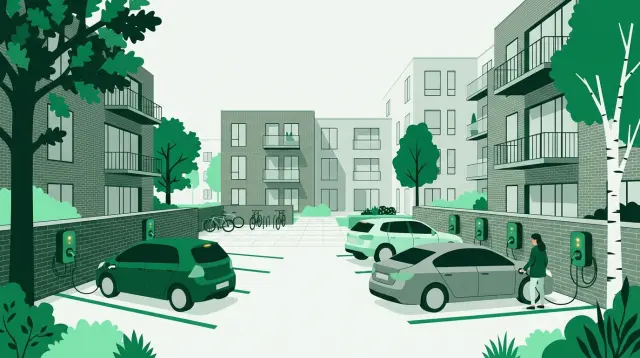
From 2026 you have the right to have a charger installed in rented homes, social housing, owner-occupied flats and housing co-operatives (andelsboliger). If you have your own parking space, you can get your own charger. With shared parking, the charger must be usable by everyone. The association or landlord can only refuse for weighty reasons, and you pay for the installation yourself. Read more in the guide If you live in a flat.
 Home EV charger: buy, rent or subscription
 Smart charging and hourly electricity prices
 Danish electricity tax (elafgift) and EV refunds
 EV charging when you live in a flat